Contact Us

Name

Email *

Message *

Showing posts with label Sri Rudram. Show all posts

Wednesday, 1 March 2017

Sri Rudropasana


The root of the Devata-Tree


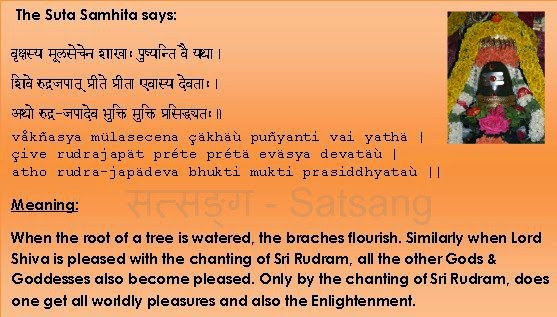
In Soothasamhita it is said

वृक्षस्य मूलसेकेन शाखः पुष्यन्ति वै यथा
शिवे रुद्रजपात् प्रीते प्रीता एवस्य देवताः
अथो रुद्र्जपादेवः मुक्ति भुक्ति प्रसिध्यश्चतु 

Vrikshasya Moolasekena Shaakhaha Pushyanthi Vai Yatha
Shive Rudrajapaath Preethe Preetha Evasya Devathaah
Atho Rudrojapadevah Mukthi Bhukthi Prasidhyaschathu

Meaning: As by pouring water at the root of a tree, all its branches are nourished, by pleasing Sri Rudra, through Rudrajapa, all the Devas are pleased. One attains Bhukthi and Mukthi, enjoyment and freedom from the ills of the world by chanting the Sri Rudram with devotion.

Monday, 20 February 2017

Sri Rudra Roopam Dhyanam

 नमः शिवाय 

Worship of Shivalinga


The popular belief is that the Shiva Lingam represents the phallus or the virile organ, the emblem of the generative power or principle in nature. This is not only a serious mistake, but also a grave blunder. In the post-Vedic period, the Linga became symbolical of the generative power of the Lord Shiva. Linga is the differentiating mark. It is certainly not the sex-mark. You will find in the Linga Purana: Pradhanam prakritir yadahur-lingamuttamam; Gandhavarnarasairhinam sabda-sparsadi-varjitam - The foremost Linga which is primary and is devoid of smell, colour, taste, hearing, touch, etc., is spoken of as Prakriti (Nature).

Linga means ‘mark’, in Sanskrit. It is a symbol which points to an inference. When you see a big flood in a river, you infer that there had been heavy rains the previous day. When you see smoke, you infer that there is fire. This vast world of countless forms is a Linga of the Omnipotent Lord. The Shiva Linga is a symbol of Lord Shiva. When you look at the Linga, your mind is at once elevated and you begin to think of the Lord.

Lord Shiva is really formless. He has no form of his own and yet all forms are His forms. All forms are pervaded by Lord Shiva. Every form is the form or Linga of Lord Shiva.

Sunday, 19 October 2014

Greatness of Ambal


AMBAL & SHIVA

Although these are of the same tathvam (principle), more than Shiva, to Ambal (Shakti) is the greatness; this, Adi Shankara Bhagavadhpadhal explains in his 'Soundaryalahari' sthothram.

shivaH shaktyA yukto yadi bhavati shaktaH prabhavituM
na cedevaM devo na khalu kushalaH spanditumapi |
atas tvAm ArAdhyaaM hari-hara-viri~nchAdibhir api
praNantuM stotuM vA katham akR^ita puNyaH prabhavati || 1 ||

Saturday, 12 October 2013

SRI RUDRAM - NAMAKAM AND CHAMAKAM


“RUDRA” is one of the names of Lord Siva, the word overtly means anger or fury. However One can understand the subtle meaning of this word ‘Rudram’ by looking at its etymology. Rudram is derived from two words – ‘Rud’ and ‘Ra’. ‘Rud’ means dukham (sorrow) or paapam (sin, demerit). ‘Rud’ also means the cause of sorrows or sins. What is the cause of sorrow or sin? It is agnyanam (ignorance). ‘Ra’ means eliminator. So Rudram means eliminator of sorrows and sins. Lord Siva get the name Rudra because he removes sorrows and sins and also the cause of those which is ignorance. Sri Rudram talks about the glory of Siva.“ Sri Rudram is a vedic hymn describing Lord Siva’s several aspects, viz. His omniscience, omnipresence, omnipotence etc.

The Rudram-Chamakam figures in the 4th of the 6 Kandas of the Taittiriya Samhita of the Yajur Veda. It is also called the Satarudriyam because versions of it are to be found in the more than 100 Sakas of the Yajur and other Vedas. At it's core is to be found the Panchakshara Mantra - na ma si va ya - the five-lettered Mantra considered among the holiest of Mantras.